Data · updated 2 September 2026
Europe's Night-Train Revival Is Going Into Reverse
Everyone has written the night-train comeback. The 2026 data points the other way: more cross-border sleepers were withdrawn than launched, as government subsidies dry up — even though the overnight train beats the plane on both cost and carbon. Below is the full, sourced picture. Free to cite with credit to SleeperTrain.co.uk.
"For three years the story has been the night-train revival. The 2026 numbers tell a quieter one — more cross-border sleepers were cut than launched, and it's government funding, not passenger demand, deciding which survive. The sleeper wins on cost and carbon; it's losing on politics."
— Cara Smith, SleeperTrain.co.uk
Europe lost 3 cross-border night-train routes on net in 2025–26: five withdrawn against two launched.
France scrapped two Paris sleepers in a single day — ÖBB Nightjet's Vienna–Paris and Berlin–Paris both ran for the last time on 14 December 2025 after the French government ended their funding.
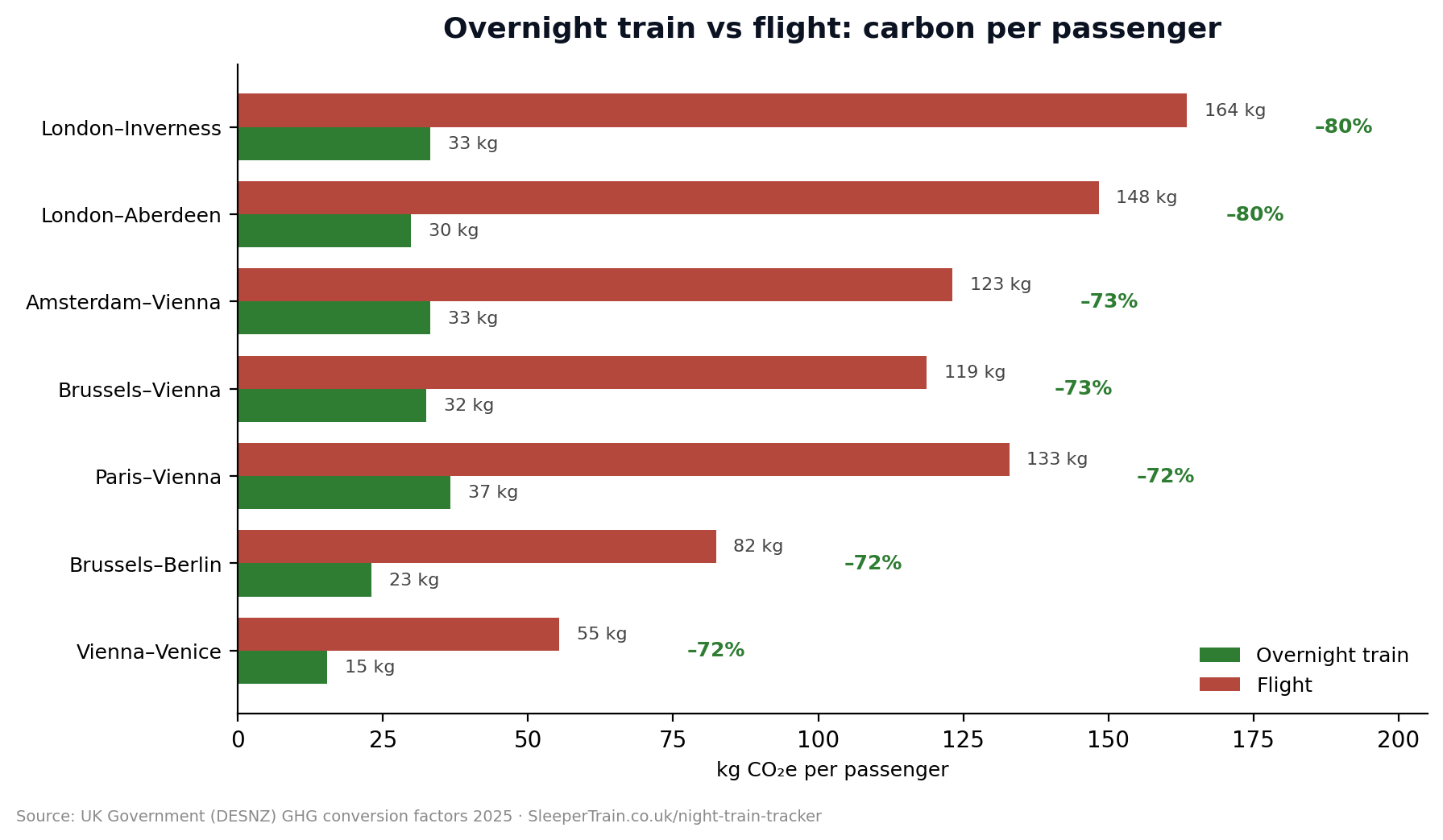
Britain's London–Inverness sleeper emits about 80% less CO2 than the flight (33 kg vs 164 kg).
Every European night train in our sample beats the plane on carbon by at least 72%.
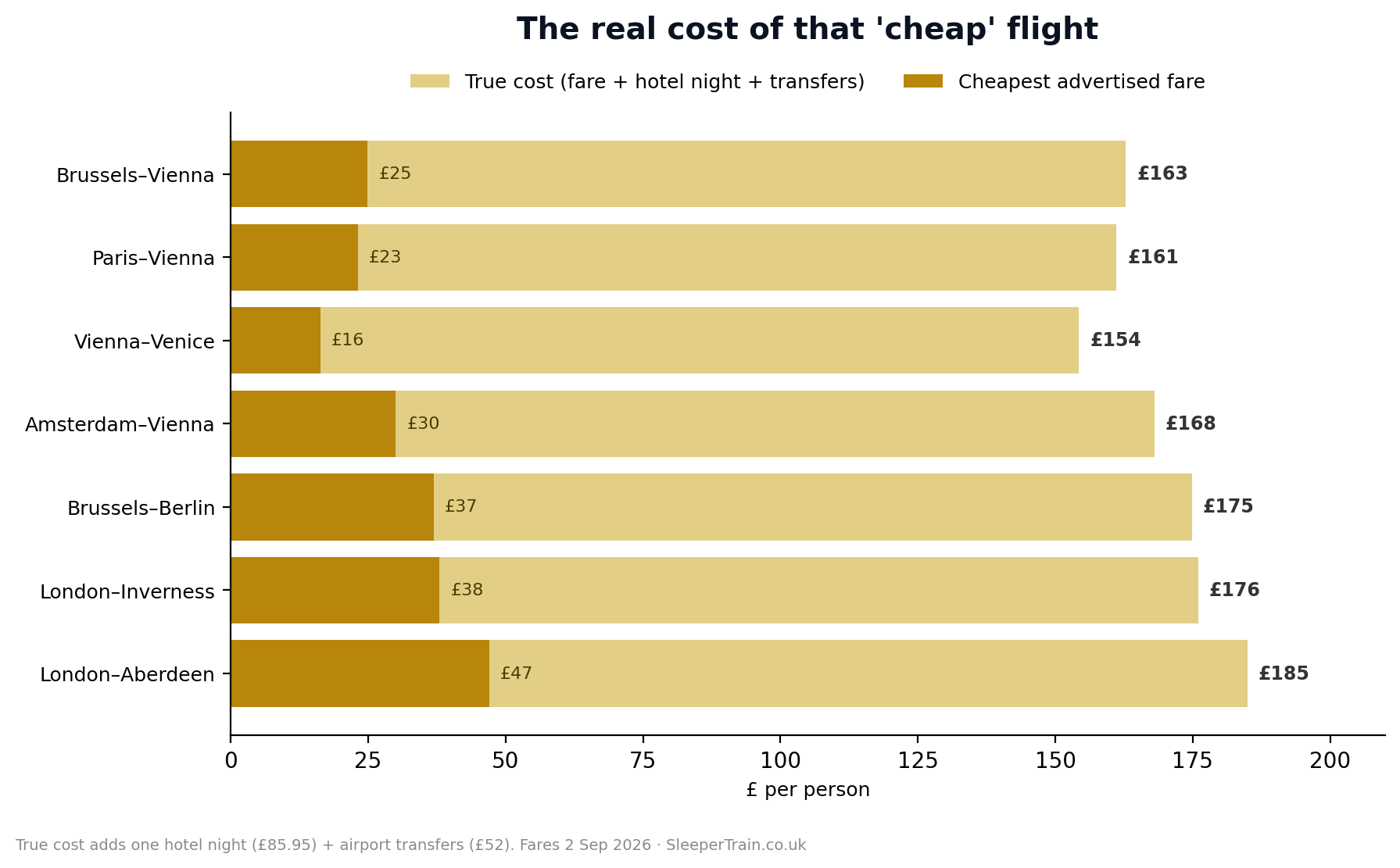
A flight advertised from £24.89 (Brussels–Vienna) really costs £162.84 once you add the hotel night the sleeper saves and airport transfers — the sleeper seat is £25.66.
Two British sleeper destinations you can't fly to: Fort William and Penzance have no commercial airport.
Europe's night trains in 2026 — the changes
Net: −3 routes (2 launched, 5 withdrawn).
Launched in 2026
| Operator | Route | Date | Note | Source |
|---|---|---|---|---|
| European Sleeper | Paris – Brussels – Berlin | 26 Mar 2026 | Revives the corridor after ÖBB/SNCF Nightjet exit | International Railway Journal |
| European Sleeper | Brussels – Switzerland – Milan | 9 Sep 2026 | Via Cologne, Bern and Stresa; 3× a week | Seat61 |
Withdrawn / discontinued 2025–26
| Operator | Route | Date | Reason | Source |
|---|---|---|---|---|
| ÖBB Nightjet | Vienna – Paris | 14 Dec 2025 | French government ended public-service funding | Railway PRO |
| ÖBB Nightjet | Berlin – Paris | 14 Dec 2025 | Same French funding withdrawal (corridor later revived by European Sleeper) | Railway PRO |
| ÖBB Nightjet | Berlin – Brussels | 28 Mar 2026 | Construction disruption and lower demand | Euronews |
| ÖBB Nightjet | Vienna/Munich – La Spezia | Dec 2025 | Cut from the 2026 timetable amid construction work | Night Ride |
| SJ (Sweden) | Stockholm – Berlin | ends 31 Aug 2026 | Swedish government withdrawing the subsidy | Trenvista |
Sleeper vs flight — cost and carbon
Carbon on official UK Government (DESNZ 2025) factors; the "true cost of flying" adds the hotel night the overnight train saves plus airport transfers. Fares are "from" prices and will move — the carbon figures are the stable core.
| Journey | Operator | Train CO₂ | Plane CO₂ | Saving | Flight from | True cost of flying |
|---|---|---|---|---|---|---|
| London – Inverness | Caledonian Sleeper | 33.2 kg | 163.5 kg | 80% | £38 | £175.95 |
| London – Aberdeen | Caledonian Sleeper | 29.9 kg | 148.3 kg | 80% | £47 | £184.95 |
| London – Fort William | Caledonian Sleeper | 32.3 kg | — | no airport to fly to | — | — |
| London – Penzance | GWR Night Riviera | 18.7 kg | — | no airport to fly to | — | — |
| Brussels – Vienna | ÖBB Nightjet | 32.5 kg | 118.7 kg | 73% | £24.89 | £162.84 |
| Paris – Vienna | ÖBB Nightjet | 36.7 kg | 132.9 kg | 72% | £23.17 | £161.12 |
| Vienna – Venice | ÖBB Nightjet | 15.4 kg | 55.4 kg | 72% | £16.31 | £154.26 |
| Brussels – Berlin | European Sleeper | 23.1 kg | 82.4 kg | 72% | £36.91 | £174.86 |
| Amsterdam – Vienna | ÖBB Nightjet | 33.2 kg | 123.1 kg | 73% | £30.04 | £167.99 |
Method & sources
Carbon = route distance × the relevant DESNZ 2025 emission factor (train 0.03546; domestic flight 0.22928; European short-haul 0.128 kg CO2e/passenger-km, flights including radiative forcing). The conservative national-rail factor is applied to all trains; DESNZ's dedicated international-rail factor (0.00446) would lift European savings to ~97%. "True cost of flying" = flight lead-in fare + £85.95 (one hotel night the overnight train saves — Premier Inn UK average room rate, Whitbread FY25) + £52 (airport transfers, 2 × Heathrow Express single £26). Fares are dynamic "from" prices captured 2 Sep 2026 and will change; the carbon savings and route-tracker facts are the stable core.
- • UK Government / DESNZ — Greenhouse Gas Reporting: Conversion Factors 2025
- • Caledonian Sleeper fares & distances (via Seat61)
- • GWR Night Riviera fares & distances (via Seat61)
- • ÖBB Nightjet routes & fares (via Seat61)
- • European Sleeper routes & fares (via Seat61)
- • Flight distances — Air Miles Calculator (great-circle)
- • Heathrow Express fares
- • Premier Inn average room rate — Whitbread investor results (FY25)
- • Eurostar carbon comparison (London–Paris ~90% less than flying)
For journalists
All figures are free to use and quote with credit to SleeperTrain.co.uk (a link is appreciated). For the full data, a chart, or a specific route breakdown, email cara@sleepertrain.co.uk.