Scotland
Scottish Highlands
The Highlands are one of Britain's strongest markets for a converted-carriage stay — and one of its scarcest in supply. Since Rogart's famous Sleeperzzz closed in 2023, genuinely bookable Highland carriage lets can be counted on one hand, which is as much an opportunity as a warning. If you're weighing up buying and converting a carriage up here, this is what the ground actually looks like.
Carriages in Scottish Highlands →Wales
Wales
Wales has a deeper bench of operating carriage stays than most of Britain — from the Cardigan Bay coast to the Black Mountains — and a heritage-railway network that occasionally puts real stock onto the market. It also has its own distinct tax and licensing rules that catch out buyers who assume England's apply. Here's the Welsh picture.
Carriages in Wales →England
Cornwall
Cornwall practically invented the premium carriage stay: Railholiday has run restored carriages here for around two decades and swept national sustainable-tourism awards. That pedigree proves the demand — but it also means strong local politics on second homes, and stock that only surfaces through the heritage-railway network. Here's what buying into Cornwall really involves.
Carriages in Cornwall →England
Yorkshire Dales
Yorkshire is quietly one of the best-supplied carriage-stay markets in England, with working examples from Nidderdale to the North York Moors and heritage lines that genuinely sell surplus stock. The catch is the national parks: siting matters enormously, and an exposed greenfield plot is far harder to get through planning than a screened old-station or farm site. Here's the Yorkshire reality.
Carriages in Yorkshire Dales →England
Lake District
The Lake District is a top-tier staycation market, but it comes with two honest caveats for a carriage buyer: genuine standard-gauge carriage lets inside Cumbria are rare (several 'carriage' stays are replicas or railway-styled builds), and the local heritage lines are poor sources of convertible stock, so sourcing is national. World Heritage status also makes planning genuinely strict. Here's the accurate picture.
Carriages in Lake District →England
Devon
Devon pairs two national parks with a long double coastline, and it already has operating carriage stays from the Exe Valley to the Haldon Hills. It also sits next door to Cornwall's Railholiday, so the market is proven. The watch-outs are national-park planning (Dartmoor and Exmoor are both strict) and Devon's newer second-home council-tax premiums. Here's the county in detail.
Carriages in Devon →England
Cotswolds
The Cotswolds is one of England's strongest short-break markets — honey-stone villages, an affluent London-in-90-minutes catchment, and couples who pay a premium for something characterful. A converted carriage fits that brief perfectly, but the landscape designation means siting is scrutinised. Here's the Cotswolds picture.
Carriages in Cotswolds →England
Peak District
The Peak District — Britain's first national park and one of its most-visited — is a huge, accessible staycation market ringed by big northern and Midlands cities. Genuine converted-carriage stays here tend to surface on the fringes and via Airbnb rather than dedicated sites, and national-park planning is strict, so siting and sourcing are the whole game. Here's the honest picture.
Carriages in Peak District →England
Norfolk & Suffolk
East Anglia is quietly a carriage-stay hotspot, with several established, own-site operators already trading across Norfolk and Suffolk. Flat, cyclable country, big beaches and a strong staycation market make it a proven place to run a converted carriage. Here's the regional detail.
Carriages in Norfolk & Suffolk →Scotland
Scottish Borders
The Borders trade on rolling country, literary heritage and easy reach of Edinburgh — and the reopened Borders Railway has put day-trippers back on the map. There's a genuine operating carriage stay here to prove the model, but Scotland's licensing regime is the decisive detail. Here's the picture.
Carriages in Scottish Borders →England
Northumberland
Northumberland's pitch is space and sky: England's least-crowded national park, one of Europe's largest protected dark-sky areas, a UNESCO wall and an empty, castle-studded coast. That seclusion is exactly what a characterful carriage stay sells — and there are operating examples to prove it. Here's the detail.
Carriages in Northumberland →England
Kent & Sussex
The South East is arguably the best-sourced carriage-stay region in the country: several converted carriages already trade here, some sited right beside working heritage lines, inside a dense and affluent London day-trip catchment. If you want proven demand and nearby stock, this is it. Here's the picture.
Carriages in Kent & Sussex →England
Shropshire
Shropshire and the Welsh Marches are quietly one of the best places in England to do this: several own-site carriage operators already trade here, a world-class heritage line runs through it, and there's even a Shropshire business that specialises in selling redundant rail stock. Undiscovered, characterful and well-sourced. Here's the detail.
Carriages in Shropshire →Scotland
Dumfries & Galloway
South-west Scotland is underrated and uncrowded, with the UK's first Dark Sky Park and a gentle 'Scottish Riviera' coast. There's a genuine operating carriage stay here to prove the model — and, as everywhere in Scotland, a mandatory licence to plan around. Here's the picture.
Carriages in Dumfries & Galloway →England
Somerset & Exmoor
Somerset pairs Exmoor's coast-and-moor with Britain's longest standard-gauge heritage line — and there's a carriage stay sited right beside it. Between a dark-sky reserve, classic honeypots and a genuine sourcing point on the doorstep, it's a strong, coherent place to buy. Here's the detail.
Carriages in Somerset & Exmoor →Wales
Pembrokeshire
Pembrokeshire has the UK's only truly coastal national park and a staycation pedigree to match — and there are operating carriage stays along Cardigan Bay to prove it. It is also, by some distance, the most regulation-heavy of any region here, so the rules deserve careful reading before you buy. Here's the picture.
Carriages in Pembrokeshire →Before you commit a five-figure sum
Don't guess what your carriage will cost. Know.
The most expensive mistake in this whole process is finding out the real number — craneage, groundworks, utilities, change-of-use — after you've already bought. One overlooked line item can cost more than the carriage. Two ways to make sure that doesn't happen to you:
Recommended · done entirely for you
Bespoke Carriage Feasibility Report
You don't lift a finger. We get on a call, take your actual site, budget and plan, and hand you back a complete cost-and-ROI model with a written go / no-go you can put in front of a bank or a partner. If one hidden cost would have blown your budget, this finds it before your money does.
- ✓A one-to-one intake call to capture your site, access, intended use and budget
- ✓A fully-built cost and ROI model for YOUR specific project — not a blank template
- ✓Site-specific risk flags: access and craneage, groundworks, utilities, planning and change-of-use
- ✓A written go / no-go recommendation with the assumptions and sensitivities spelled out
- ✓The £29 workbook included, pre-filled with your figures so you can keep iterating
- ✓£350 fully credited against sourcing if you go ahead with us
A £30,000+ decision
£350
Credited back in full against sourcing if you proceed with us — so if you go ahead, it costs you nothing.
Get your feasibility report →One project, assessed by a human. Limited slots.
Or — run the numbers yourself first
Railway Carriage Cost & ROI Workbook
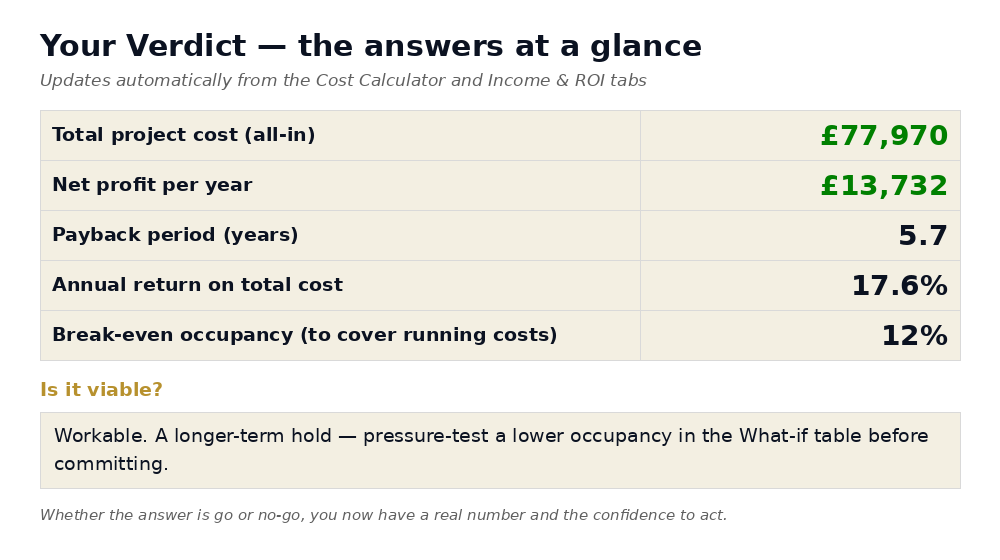
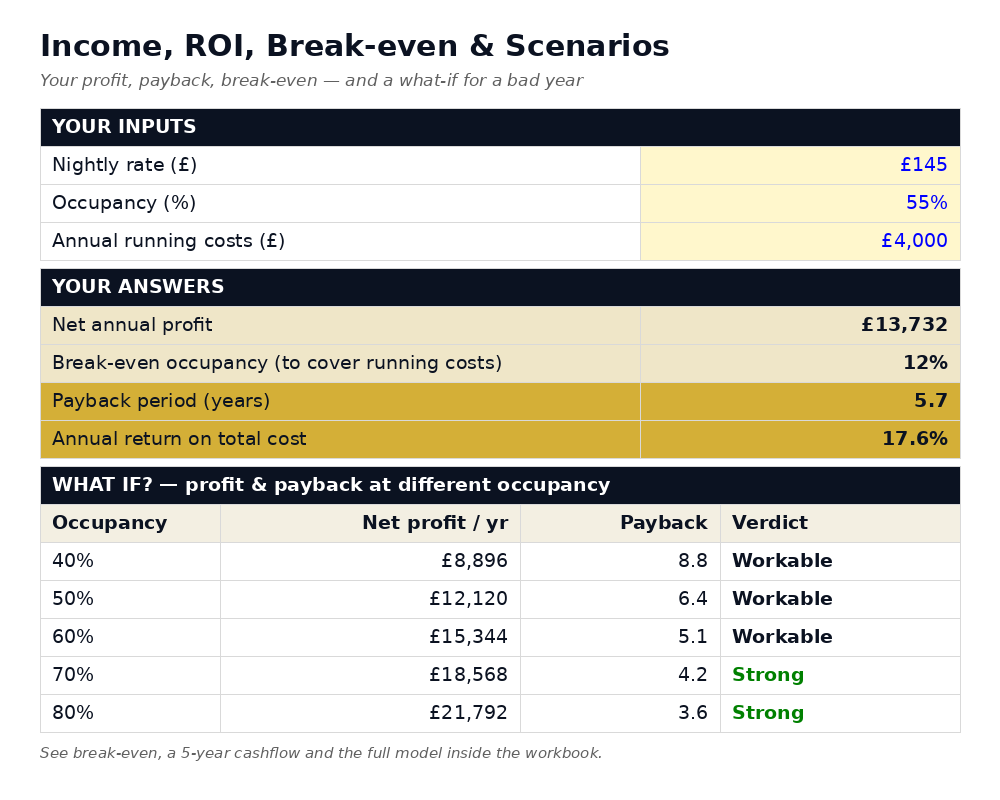
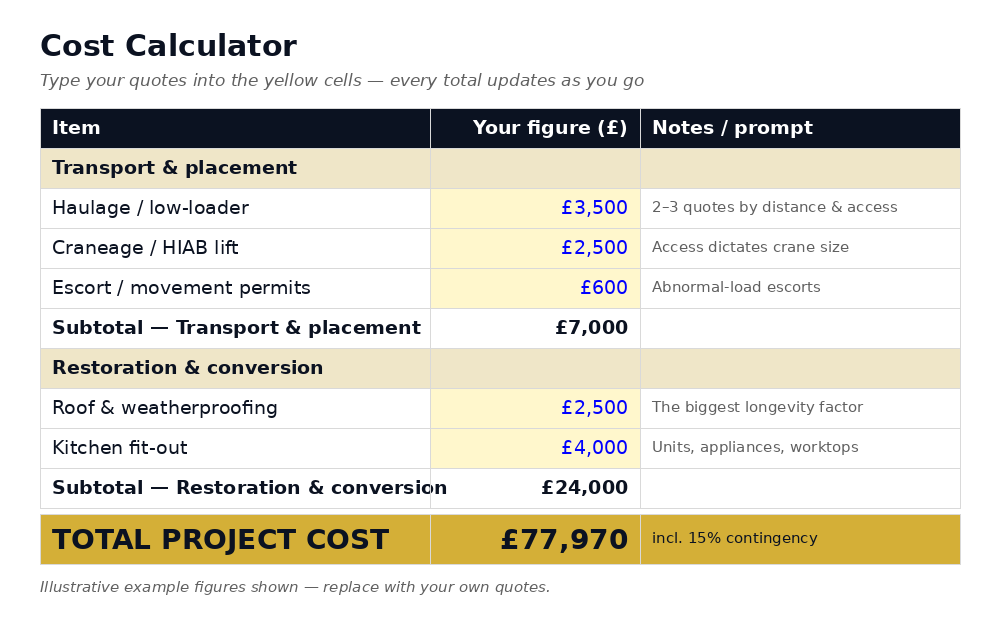
Not ready for the full report? Get the same model as a working Excel you fill in yourself. Type in your own quotes and it totals your true all-in cost, payback, annual return and the occupancy you need to break even — with a plain go / no-go on one screen.
A peek inside the workbook